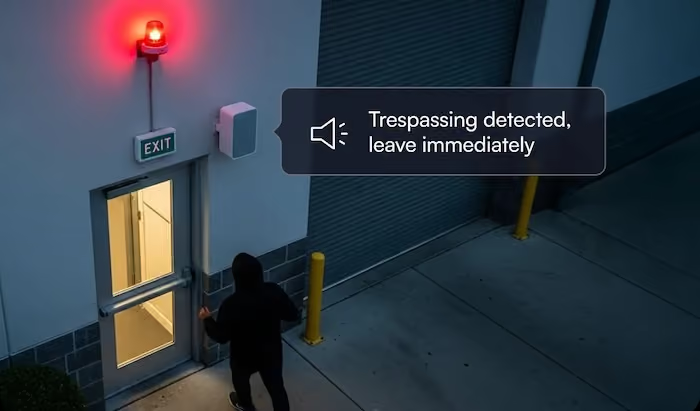
This article examines Avigilon's real-time threat detection capabilities, identifies where the platform falls short for multi-site organizations, and explains how Lumana's behavioral AI and camera-agnostic architecture deliver more accurate alerts with less operational complexity.
What does Avigilon offer for real-time threat detection?
Avigilon, now part of Motorola Solutions, provides enterprise video security through two product lines: the cloud-native Alta platform and the on-premises Unity platform. Both platforms focus on object detection—identifying people, vehicles, and items in camera feeds—rather than analyzing whether behavior patterns indicate genuine threats.
Avigilon's AI-powered video analytics
Avigilon's analytics center on recognizing objects rather than understanding behavior. The platform offers appearance search to locate specific people or vehicles across camera feeds, license plate recognition, facial recognition, and Focus of Attention technology that directs PTZ cameras toward detected motion.
The Unity platform includes AdaptAI analytics, while Alta provides cloud-based analytics through serverless architecture. Both rely heavily on identifying what appears in a scene rather than determining whether activity is actually suspicious.
Avigilon's hardware and infrastructure requirements
Avigilon emphasizes proprietary hardware integration. The company manufactures its own cameras with HDSM SmartCodec technology to optimize bandwidth and video quality. While Alta offers cloud connectors for third-party ONVIF cameras, the system performs best with Avigilon-branded hardware.
The Unity platform requires dedicated on-premises servers, storage infrastructure, and ongoing IT management. Organizations bear responsibility for hardware maintenance, software updates, and cybersecurity hardening even with cloud-managed conveniences.
Avigilon's integration and scalability
Avigilon maintains a Technology Partner ecosystem with integrations for identity platforms like Okta and Microsoft Entra ID. The platform supports ONVIF standards in Unity VMS for third-party device compatibility.
Scaling across multiple sites typically requires managing separate instances or deploying cloud connectors. Multi-site deployments demand additional configuration and management overhead that grows as organizations expand.
Where Avigilon falls short for real-time threat detection
While Avigilon has established itself as a major player in video security, several structural limitations cause organizations to seek alternatives.
- Proprietary camera lock-in: Avigilon's business model centers on its proprietary camera hardware. Although Alta Cloud Connectors allow integration with third-party ONVIF cameras, the system is optimized for Avigilon-branded cameras. Organizations that have invested in other camera brands face vendor lock-in that represents significant capital expense and operational disruption.
- On-premises complexity: The Unity platform requires organizations to manage dedicated on-premises servers, handle software updates, maintain cybersecurity posture, and provision adequate storage. This complexity increases deployment timelines, requires specialized IT expertise, and diverts resources from core security operations.
- High false positive rates: Avigilon's analytics rely on object detection rather than behavioral analysis. Object-focused analytics generate excessive false positives in complex environments—crowded retail spaces, manufacturing floors with repetitive motion, or educational facilities with constant activity. Security teams become fatigued by alert noise, reducing the effectiveness of real-time threat detection.
What to look for in a real-time threat detection system
When evaluating alternatives to Avigilon, you should prioritize characteristics that ensure a genuine upgrade in threat detection capability.
- Behavioral AI: The system should analyze suspicious behavior patterns—loitering, unusual movement trajectories, unauthorized access attempts—rather than simply identifying what objects appear in a scene.
- Camera-agnostic architecture: Choose a platform that works with your existing cameras and any future cameras you deploy. This eliminates vendor lock-in and protects your hardware investments.
- Cloud-native with hybrid resilience: The platform should operate primarily in the cloud for scalability while maintaining local edge processing—which cuts cloud transmission costs by 40–60%—so operations continue if internet connectivity is lost.
- Low false positive rates: With 98% of security alarm activations being false according to the IACP, advanced AI should reduce alert noise by filtering out routine activity. Your security team can then focus on genuine threats instead of chasing false alarms.
- Unified multi-site management: A single dashboard should provide visibility and control across all locations without requiring you to manage separate systems or connectors.
How Lumana delivers real-time threat detection beyond Avigilon
Lumana is purpose-built to address the limitations organizations face with legacy systems like Avigilon. The platform empowers organizations with proactive security and advanced video intelligence that works with any camera.
AI that detects suspicious behavior, not just objects
Lumana's proprietary VIA-1 AI model recognizes behavioral anomalies and suspicious patterns rather than simply identifying objects. The system continuously learns from your specific environment, adapting to normal activity patterns and automatically flagging genuine threats.
This behavioral focus dramatically reduces false positives. Your security team responds to real threats rather than chasing alert noise from every person or vehicle that enters the frame. Lumana's AI Agents automate monitoring, response, and investigation workflows, turning raw video into actionable intelligence.
Camera-agnostic architecture for any IP camera
Lumana works with any IP camera—existing or new—eliminating vendor lock-in and protecting your hardware investments. Whether your organization uses cameras from Axis, Hikvision, Dahua, or any other ONVIF-compliant manufacturer, Lumana integrates seamlessly.
This flexibility allows you to standardize on the cameras that best fit your needs, procurement preferences, and budget. You are never forced into a proprietary ecosystem or required to replace working hardware to access advanced AI capabilities.
Cloud-native platform with hybrid resilience
Lumana operates as a cloud-native platform, eliminating the need for dedicated on-premises servers and complex infrastructure management. You deploy and manage the system entirely through the cloud, with centralized visibility across unlimited locations.
Lumana maintains hybrid resilience through Lumana Core edge processing. If internet connectivity is lost, the system continues operating locally, storing video and alerts until the connection is restored. This hybrid approach provides cloud simplicity with on-premises reliability.
Avigilon vs. Lumana for real-time threat detection at a glance
| Capability | Avigilon | Lumana |
|---|---|---|
| AI approach | Object detection and recognition | Behavioral analysis and anomaly detection |
| Camera compatibility | Proprietary cameras optimized; third-party via cloud connectors | Camera-agnostic; works with any IP camera |
| Deployment model | Cloud (Alta) or on-premises (Unity); requires infrastructure management | Cloud-native with hybrid edge resilience |
| False positive rate | High (object-focused analytics) | Low (behavioral AI reduces alert noise) |
| Multi-site management | Separate instances or cloud connectors | Unified cloud dashboard across unlimited locations |
| Offline operation | Limited (Unity has local storage; Alta requires internet) | Continues operating locally with cloud backup |
| Vendor lock-in | High (proprietary cameras and ecosystem) | None (works with any IP camera) |
Avigilon vs. Lumana feature comparison
Understanding how these platforms differ across key capabilities helps you make informed decisions about your security infrastructure.
AI analytics and alert accuracy
Avigilon's analytics engine focuses on object detection—identifying people, vehicles, packages, and other items in a scene. While this approach works in controlled environments, it generates high false positive rates in complex spaces like retail stores, warehouses, and educational institutions. Security teams receive constant alerts for routine activity, leading to alert fatigue and slower response to genuine threats.
Lumana's VIA-1 model analyzes behavior instead. The system learns what "normal" looks like at your specific location and alerts only when suspicious patterns emerge. This includes loitering in restricted areas, unauthorized access attempts, or unusual movement trajectories. The behavioral focus reduces false positives dramatically, allowing your team to focus on real threats.
Deployment and system management
Avigilon requires you to choose between cloud-native (Alta) and on-premises (Unity) architectures. Unity deployments demand dedicated servers, ongoing infrastructure maintenance, and IT expertise. Even with cloud connectors, managing Avigilon across multiple locations introduces operational complexity that requires specialized knowledge.
Lumana deploys entirely in the cloud, eliminating infrastructure management overhead. You access the platform through a web or mobile interface without managing servers, software updates, or cybersecurity patches. Lumana Core edge processing ensures that if connectivity is lost, the system continues operating locally and syncs when restored.
Video search and investigation speed
Avigilon's search capabilities require navigating through object detection results and reviewing footage manually. In complex environments with high detection noise, finding relevant footage becomes time-consuming and frustrating for investigators.
Lumana's Smart Search allows you to filter by multiple parameters—behavior type, time, location—and includes Text Search for natural language queries. Because Lumana's AI focuses on behavioral events rather than every object in a scene, search results are more relevant and investigations move faster.
Scalability across multiple sites
Avigilon requires you to manage separate instances or cloud connectors for each location. This introduces operational overhead that grows as your organization expands. Multi-site deployments become increasingly complex to configure and maintain.
Lumana provides unified cloud management across unlimited locations from a single dashboard. You can view live and historical video, manage alerts, conduct searches, and generate reports across all sites without managing separate systems or dealing with connector configurations.
Who benefits most from switching to Lumana?
Organizations across multiple industries benefit from Lumana's behavioral AI and camera-agnostic architecture.
- Retail environments: With shoplifting incidents up 18% per the NRF, reduce theft through behavioral detection of suspicious shopping patterns without false positives from detecting every customer movement.
- Warehouses and logistics facilities: Monitor for unauthorized access and unsafe behaviors across large spaces without overwhelming security teams with constant alerts.
- Healthcare facilities: Protect patients and staff by detecting unusual behavior patterns while maintaining compliance requirements.
- Enterprise and corporate campuses: Scale across multiple buildings with unified management and consistent security policies.
- Educational institutions: Enhance campus safety without the operational burden of on-premises infrastructure or specialized IT staff.
- Government and public sector: Deploy rapidly with zero vendor lock-in and maintain compliance through SOC 2 Type II certification and NDAA-compliant hardware options.
Why Lumana is the smarter choice for real-time threat detection
The question of whether a system better than Avigilon exists for real-time threat detection has a clear answer. Lumana represents a fundamental advancement in how organizations detect and respond to threats.
Avigilon's object-focused analytics, proprietary camera requirements, and on-premises infrastructure complexity reflect an older generation of video security. These limitations force you to accept high false positive rates, vendor lock-in, and operational burden—all of which undermine real-time threat detection effectiveness.
Lumana's behavioral AI eliminates false positives by understanding what "normal" looks like at your location and alerting only on genuine threats. The camera-agnostic architecture protects your hardware investments and gives you freedom to choose any camera. Cloud-native deployment with hybrid resilience provides simplicity without sacrificing reliability.
Most importantly, Lumana addresses the core reason organizations search for alternatives to Avigilon: the need for threat detection that actually works. Fewer false alerts, faster investigations, easier operations, and genuine protection for the people and assets you are responsible for.
Request a product demo to see how Lumana's behavioral AI detects real threats in your environment.
Frequently asked questions
Can Lumana work with existing Avigilon cameras?
Yes, Lumana is camera-agnostic and works with any IP camera, including Avigilon-branded cameras that support ONVIF standards. You can migrate from Avigilon without replacing your camera hardware, protecting your existing investments while gaining Lumana's behavioral AI capabilities.
What is the difference between Avigilon and Genetec?
Both Avigilon and Genetec are established players in unified physical security platforms. Avigilon focuses on video security with proprietary cameras, while Genetec provides a unified platform covering video, access control, and incident management with emphasis on integrations. Neither offers the behavioral AI focus or camera-agnostic simplicity of Lumana.
Does Lumana require on-premises servers?
No, Lumana is a cloud-native platform with no on-premises servers required. Lumana Core edge processing devices provide local processing and storage for resilience, but these are lightweight appliances—not servers requiring infrastructure management or cybersecurity hardening.