AI weapon detection offers organizations a way to enhance security monitoring across existing camera systems, but understanding its real-world accuracy and limitations is essential before deployment. This article covers how the technology works, what independent evidence shows about its effectiveness, key limitations you should consider, and how to evaluate whether AI weapon detection fits your security strategy.
What is AI weapon detection and how does it work on existing cameras?
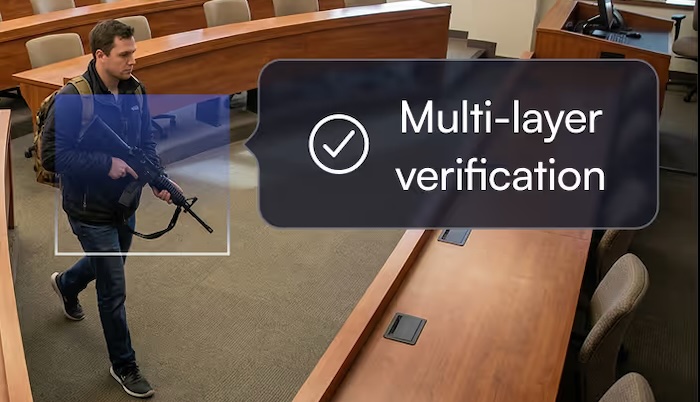
AI weapon detection is computer vision technology that identifies firearms and other weapons in video feeds from security cameras. The system analyzes each video frame in real time, looking for visual patterns that match known weapon characteristics. When the AI recognizes a potential threat, it sends an alert to security personnel for immediate review.
This technology integrates directly with existing IP camera infrastructure. You don't need to replace your current cameras to use it. The AI software connects to standard security cameras, DVRs, and video management systems you already have in place.
Machine learning models trained on thousands of weapon images enable the system to recognize firearms, knives, and other threats as they appear on screen. The technology represents a significant shift from traditional security monitoring, where human operators must watch multiple screens simultaneously. AI weapon detection can monitor dozens or hundreds of camera feeds continuously without fatigue or distraction.
- Computer vision analysis: The AI examines video frames to identify visual characteristics associated with weapons, such as shape, size, and how objects are held
- Real-time processing: Detection happens as footage is captured, enabling immediate alerts rather than requiring manual review of recorded video
- Camera-agnostic integration: Works with most standard IP cameras and existing security systems without requiring hardware replacement
How accurate is AI weapon detection compared to manual monitoring?
AI weapon detection accuracy varies significantly based on environmental conditions, camera quality, and how you configure the system. No AI weapon detection system achieves perfect accuracy. You should expect both false positives, with documented cases including a clarinet mistaken for a gun, and false negatives (missed actual weapons). Understanding these limitations is essential for setting realistic expectations.
Several factors directly affect detection performance. Camera resolution plays a major role because higher-quality images provide more detail for the AI to analyze. Lighting conditions matter significantly, with poor lighting, shadows, and backlighting all reducing accuracy. The distance between the camera and the subject, along with the angle of view, also influences whether the system can correctly identify a weapon.
Compared to manual monitoring, AI weapon detection offers one clear advantage: it never gets tired. Human security operators monitoring multiple screens experience attention fatigue, especially during long shifts. Studies show that human attention to video feeds drops significantly after just 20 minutes of continuous monitoring. AI systems maintain consistent vigilance across all cameras around the clock.
However, AI systems lack the contextual understanding that humans bring to security monitoring. A human operator can recognize that a prop weapon in a theater production poses no threat, while an AI system might generate an alert. This is why most security experts recommend AI weapon detection as a tool to assist human operators rather than replace them entirely.
- Environmental factors: Lighting quality, camera resolution, weapon visibility, distance from camera, and background complexity all affect accuracy
- Consistency advantage: AI systems eliminate fatigue and maintain attention across all cameras continuously
- Contextual limitations: Human operators bring judgment that AI currently cannot match, making human oversight essential
What does independent evidence reveal about AI weapon detection effectiveness?
Independent testing of AI weapon detection systems has produced mixed results. Performance varies widely between vendors and deployment conditions. Third-party evaluations have found that some systems perform well under controlled conditions but struggle in real-world environments with variable lighting, crowds, and partially concealed weapons.
Published evaluations from security research organizations have identified several consistent findings. Detection rates tend to be highest when weapons are fully visible, held in a recognizable manner, and captured by high-resolution cameras with good lighting. Performance drops significantly when weapons are partially concealed, when subjects are moving quickly, or when environmental conditions are challenging.
One notable real-world case involved a school district that invested about $1 million in an AI weapon detection system that failed to detect a concealed firearm carried by a shooter. The weapon was not plainly visible to the cameras. This case highlights a fundamental limitation: AI weapon detection works best when weapons are exposed and clearly visible. It underscores why AI detection should be one component of a comprehensive security strategy rather than a standalone solution.
Independent researchers have also noted that vendor claims about accuracy often come from controlled testing environments that don't reflect real-world conditions, with one peer-reviewed study finding precision drops of 12–31 percentage points in real-world deployments. If you're evaluating AI weapon detection, you should request independent validation data and conduct your own testing in your specific environment before full deployment.
- Optimal conditions: Detection rates are highest with visible weapons, good lighting, and high-resolution cameras
- Real-world challenges: Performance decreases with concealed weapons, rapid movement, and variable environmental conditions
- Vendor claims versus reality: Controlled testing environments often don't reflect actual deployment conditions
What are the key limitations of AI weapon detection on existing cameras?
AI weapon detection faces several significant limitations that you must understand before deployment. Environmental challenges, technical constraints, and operational factors all affect system performance. Recognizing these limitations helps you design appropriate protocols and set realistic expectations.
Environmental challenges present some of the most significant obstacles. Extreme lighting conditions, including very bright sunlight, deep shadows, and rapidly changing light, can reduce detection accuracy. Weather conditions like rain, fog, or snow can obscure camera views. Reflective surfaces may create visual artifacts that confuse the AI system.
Technical constraints also affect performance. Older cameras with lower resolution may not provide sufficient image quality for reliable detection. The AI processing requires adequate computing power, either on-premises or in the cloud. Network bandwidth must support real-time video transmission without delays that could slow alert delivery.
Operational limitations include the fundamental challenge of camera coverage. No camera system can eliminate all blind spots, and AI weapon detection only works where cameras can see. Weapons concealed under clothing, in bags, or behind objects remain invisible to the system. Fast-moving subjects may blur in video frames, reducing detection accuracy.
How should organizations evaluate AI weapon detection for their security needs?
If you're considering AI weapon detection, you should conduct thorough evaluations before committing to any vendor or solution. This process should include reviewing independent validation data, conducting on-site testing, and developing clear protocols for alert response. A structured evaluation helps ensure the chosen solution meets your actual security needs.
When evaluating vendors, transparency about system capabilities and limitations should be a primary consideration. Ask vendors for independent testing data, not just internal performance claims. Request information about training data, including what types of weapons the system can detect and under what conditions. Understand how the vendor measures and reports accuracy.
On-site testing in your actual environment is essential. Controlled vendor demonstrations may not reflect how the system will perform in your specific conditions. Test with various lighting conditions, camera angles, and scenarios that reflect your real security concerns. Evaluate both detection rates and false positive rates during testing.
Develop clear protocols for how security staff will respond to alerts before deployment. AI weapon detection generates alerts that require human verification and decision-making. Your staff must understand their roles, response procedures, and escalation paths. Without proper protocols, even accurate detection provides limited security value.
- Request independent data: Ask for third-party testing results, not just vendor-provided performance claims
- Test in your environment: Controlled demonstrations don't reflect real-world conditions in your specific facilities
- Establish response protocols: Define how staff will verify alerts and escalate genuine threats before deployment
What role should AI weapon detection play in a comprehensive security strategy?
AI weapon detection works best as one component within a layered security approach rather than a standalone solution. Effective security strategies combine multiple protective measures, including physical barriers, access controls, trained personnel, and technology systems. AI detection enhances these layers but cannot replace them.
The concept of defense in depth applies directly to AI weapon detection deployment. Physical security measures like controlled entry points and barriers provide the first layer. Access control systems verify authorized personnel. Trained security staff provide human judgment and response capability. AI weapon detection adds continuous monitoring that augments human attention.
Human oversight remains essential for effective AI weapon detection deployment. AI systems generate alerts, but humans must verify threats and decide on appropriate responses. This human-in-the-loop approach prevents automated responses to false positives while ensuring genuine threats receive immediate attention.
Integration with existing security protocols requires careful planning. AI weapon detection alerts should flow into established communication channels and response procedures. Staff training must cover how to interpret and respond to AI alerts. Regular drills should include scenarios involving AI-generated alerts to ensure smooth coordination between technology and personnel.
- Layered approach: AI detection enhances but does not replace physical barriers, access controls, and trained personnel
- Human verification: All AI alerts require human review before initiating emergency responses
- Protocol integration: Alerts must connect to existing communication channels and response procedures
How Lumana's AI weapon detection approach addresses accuracy and reliability
Lumana's AI-powered video security platform integrates weapon detection capabilities with comprehensive video management. This enables you to leverage your existing camera infrastructure for enhanced threat detection. The platform combines real-time AI analysis with intuitive alert management tools that help security teams respond quickly and effectively.
Lumana's approach emphasizes practical accuracy improvements through several technical strategies. The platform works with any IP camera, allowing you to optimize camera placement and quality for detection performance. Cloud-based AI processing ensures consistent analysis across all camera feeds without requiring on-premises computing infrastructure.
The platform's video management capabilities complement weapon detection by providing powerful search and investigation tools. When an alert occurs, your security team can quickly review footage, search across cameras, and document incidents. This integrated approach transforms video from passive recording into active security intelligence.
For organizations evaluating AI weapon detection, Lumana offers the ability to see how the technology performs in your specific environment before full deployment. Request a product demo to see how Lumana's AI weapon detection performs on your existing camera infrastructure.
Frequently asked questions about AI weapon detection accuracy
Can AI weapon detection identify concealed firearms hidden under clothing?
AI weapon detection relies on visual analysis, so it cannot identify weapons that are fully concealed under clothing or inside bags. The technology works best when weapons are visible to the camera, which is why it should complement rather than replace other security measures like access controls and trained personnel.
How do false positive rates affect daily security operations?
False positives require your security staff to verify each alert, which takes time and attention away from other duties. High false positive rates can lead to alert fatigue, where staff become desensitized to warnings. Proper system configuration and camera placement help reduce false positives to manageable levels.
What camera resolution do you need for reliable AI weapon detection?
Higher resolution cameras generally produce better detection results because they provide more visual detail for the AI to analyze. Most AI weapon detection systems work with standard HD cameras, but you should test performance with your specific cameras before full deployment to understand any limitations.
Does AI weapon detection work effectively in outdoor environments?
Outdoor environments present additional challenges including variable lighting, weather conditions, and longer distances between cameras and subjects. AI weapon detection can work outdoors, but you should expect reduced accuracy compared to controlled indoor environments with consistent lighting.