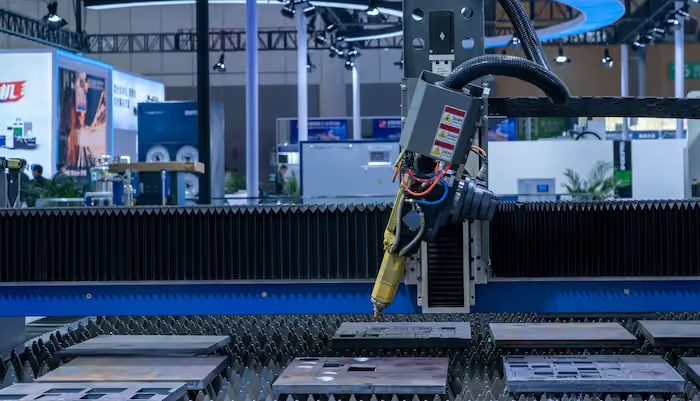
Physical AI companies build intelligent systems that perceive and act within real-world environments, transforming how enterprises and public-sector organizations approach security, logistics, and operations. This guide covers what physical AI means, profiles the leading companies in the space, and provides a framework for evaluating which solution fits your organization's needs.
What are physical AI companies?
Physical AI companies build systems that perceive, reason about, and act within real-world environments. Unlike traditional software-only AI that processes text or images on a screen, physical AI integrates computer vision, machine learning, and automated decision-making to perform tasks in warehouses, manufacturing facilities, security operations, and other mission-critical settings.
These platforms combine hardware—cameras, robots, sensors, and edge devices—with software intelligence. The result is systems that monitor operations, detect anomalies, automate responses, and generate actionable insights without constant human oversight.
Physical AI represents a significant shift from passive monitoring to proactive intelligence. Traditional systems require human operators to watch feeds and respond manually. Physical AI systems automatically identify threats, trigger alerts, and execute predefined actions without human intervention. This reduces operator fatigue, accelerates response times, and provides continuous monitoring that human teams cannot sustain around the clock.
Key characteristics of physical AI solutions:
- Real-time perception: Computer vision, which holds 45% of the physical AI market, and sensor integration enable continuous monitoring of physical spaces
- Autonomous decision-making: AI models detect conditions and trigger automated actions without waiting for human approval
- Edge and cloud processing: Hybrid architectures balance on-premises processing speed with cloud scalability
- Enterprise-grade security: Compliance certifications, encryption, and privacy controls protect sensitive data
- Integration with existing systems: APIs and webhooks connect physical AI to access control, dispatch, and operational workflows
Top physical AI companies
The physical AI landscape, projected to reach $15.28 billion by 2032 according to MarketsandMarkets, spans video security, robotics, autonomous vehicles, spatial computing, and foundational infrastructure. Each company below addresses different operational challenges. Understanding their capabilities helps you identify which solutions align with your specific needs.
1. Lumana
Lumana delivers a modern video security platform powered by proprietary AI intelligence that transforms security operations from reactive to proactive. Built on a hybrid cloud architecture, the platform combines edge processing with cloud management to provide real-time threat detection, automated response capabilities, and comprehensive video investigation across unlimited cameras and users.
The platform works with existing camera infrastructure, eliminating the need for proprietary hardware while delivering enterprise-grade security. This camera-agnostic approach means you can modernize your security operations without replacing equipment you already own.
Lumana's core strength lies in its continuous-learning VIA-1 video intelligence model. This AI adapts to each unique environment and reduces false alerts significantly over time. The platform's agentic AI enables automated actions—from triggering alerts and activating loudspeaker systems to executing lockdown protocols and dispatching emergency responders—all without manual intervention.
With support for up to 4K recording, local SSD storage with optional cloud backup, and low-bandwidth streaming, Lumana scales across small deployments and large enterprise estates.
Main features:
- VIA-1 proprietary AI model that adapts to each environment and reduces false alerts
- Hybrid cloud architecture with edge processing and optional cloud backup
- Agentic AI for automated response actions including alerts, lockdowns, dispatch, and webhooks
- VMS+ control center with browser and mobile access
- Multi-camera investigation with text and parameter-based search
- Support for unlimited cameras and users with no per-seat licensing
- Comprehensive integrations with access control, sensors, communications, and dispatch systems
Ideal for: Retail and hospitality environments, warehouses and logistics facilities, healthcare and education institutions, multi-site enterprises, and organizations prioritizing reduced false alerts and operator fatigue.
Pricing: Quote-based annual recurring license priced by number of camera feeds, storage days, and license term. All features included in every license with no tiered restrictions. Lifetime warranty on Lumana hardware and free trial available.
2. Verkada
Verkada operates a unified cloud platform that consolidates video security, access control, alarms, intercom systems, air quality monitoring, and workplace management into a single interface. The platform eliminates the need for on-premises NVRs or DVRs by storing video directly in the cloud with optional on-camera storage.
The platform requires proprietary cameras but provides simpler deployment and unified management across all security functions. You get a single dashboard for all physical security needs, though the cloud-only architecture means recording stops entirely when internet connectivity is unavailable.
Pricing: Hardware MSRPs published on pricing page with cameras ranging from mid-hundreds to several thousand dollars. Per-device software licenses available in one, three, five, and ten-year terms. 30-day free trial frequently offered.
3. Boston Dynamics
Boston Dynamics manufactures advanced mobile robots—including Spot (quadruped), Stretch (mobile case handler), and Atlas (humanoid)—alongside the Orbit fleet management and intelligence software platform. These robots are engineered for industrial inspection, material handling, and autonomous task execution in complex environments.
Spot navigates stairs, rough terrain, and confined spaces while carrying sensor payloads for data collection. Orbit provides fleet management, task scheduling, remote operations, and AI-driven insights with enterprise integrations for asset management and workflow systems.
Pricing: Hardware and software sold via direct sales engagement. Orbit software and care plans priced separately based on deployment scope. No public pricing available.
4. Covariant
Covariant develops AI-powered warehouse robotics—a sector expected to reach $24.55 billion by 2031—centered on the Covariant Brain, a universal AI platform that enables robotic systems to perform diverse picking, induction, and goods-to-person tasks with minimal human intervention. The RFM-1 Robotics Foundation Model delivers human-like reasoning and natural-language interaction capabilities.
This allows robots to handle items they have never seen before without manual programming. Covariant's systems improve continuously through fleet learning, adapting to SKU changes and operational variations without manual retraining.
Pricing: Enterprise solution-based pricing. Quote-only via direct sales engagement.
5. Samsara
Samsara provides a Connected Operations Cloud platform for fleet telematics, vehicle and equipment tracking, AI-powered camera systems, and workforce management. The platform integrates GPS tracking, vehicle diagnostics, fuel and energy monitoring, EV support, and compliance tools alongside dual-facing AI dash cameras with in-cab coaching and live streaming.
Samsara's AI models are trained on extensive real-world data and deliver edge-based processing for real-time alerts and risk detection across transportation and logistics operations. The platform serves organizations managing vehicle fleets, heavy equipment, and distributed workforces.
Pricing: Quote-only with no public tiered pricing. Modules bundled by customer needs including fleet size, hardware, and features. 30-day product trials available.
6. NVIDIA
NVIDIA provides the foundational hardware and software stack for physical AI deployments. This includes Blackwell-generation accelerators, the CUDA-X library suite, TensorRT optimization, Triton inference serving, and NVIDIA NIM microservices for deploying foundation models.
Organizations building or deploying physical AI systems rely on NVIDIA's compute infrastructure for training and inference workloads. The company's Omniverse platform enables digital twins and industrial simulations, allowing you to test physical AI systems in virtual environments before real-world deployment. Many physical AI startups build their solutions on NVIDIA infrastructure.
Pricing: NVIDIA AI Enterprise starting at per-GPU annual subscription with multi-year and perpetual options. Cloud pay-as-you-go per-GPU hourly rates plus cloud service provider costs.
7. Matterport
Matterport is a spatial data platform that digitizes physical spaces into 3D digital twins with precise measurements, annotations, and traffic analytics. The platform supports capture via mobile devices or professional 3D cameras, with Capture Services On-Demand available in hundreds of cities.
Organizations use these digital twins for facility management, real estate, construction documentation, and space planning. Advanced features include AI-powered measurements, property intelligence reports, and integrations with construction management platforms like Procore and Autodesk.
Pricing: Free plan with one active space and two users. Starter through Enterprise tiers with increasing space and user limits. Enterprise pricing available with volume discounts and SSO.
8. Tesla
Tesla manufactures electric vehicles with integrated driver-assistance features, home energy systems including Powerwall and Solar, and grid-scale energy storage through Megapack. The company operates the Supercharger network and offers Tesla Electric retail electricity plans in select markets.
While Tesla's Full Self-Driving (Supervised) is not fully autonomous, the company's vehicle and energy ecosystem represents a significant physical AI application in transportation and energy management. The Fleet API enables third-party integrations for organizations managing Tesla vehicles.
Pricing: Vehicle pricing shown on model pages, varying by configuration and location. Full Self-Driving subscription available monthly. Home energy products quote-based after address and needs assessment.
How to choose the right physical AI company
Selecting a physical AI platform depends on your specific operational needs, existing infrastructure, and long-term scalability requirements. The right choice varies significantly based on whether you need video security, robotics, fleet management, or foundational AI infrastructure.
Implementation considerations for physical AI deployments
Successfully deploying a physical AI solution requires planning beyond software selection. Infrastructure readiness, organizational change, and performance validation all impact deployment success.
Infrastructure readiness:
- Network capacity: Assess bandwidth availability for video streaming, cloud backup, and real-time alerts
- Power and connectivity: Evaluate power supply, redundancy, and cellular or wired connectivity options for edge devices
- Storage planning: Determine on-premises storage capacity, cloud backup requirements, and retention policies
Organizational change:
- Operator training: Plan training for security teams and facilities staff on new interfaces and automated workflows
- Workflow redesign: Identify how automated alerts and actions will change incident response procedures
- Success measurement: Define KPIs including incident detection time, false alert reduction, and cost savings to track ROI
Pilot deployments in a limited area often take two to four weeks. Full-scale rollouts depend on infrastructure readiness, integration scope, and organizational change management. Starting small allows you to validate AI accuracy and user experience before expanding across your organization.
FAQ
What is the difference between physical AI and traditional video surveillance?
Traditional video surveillance relies on human operators to monitor feeds and respond to events. Physical AI systems automatically detect threats, trigger alerts, and execute predefined actions without human intervention, providing continuous monitoring that human operators cannot sustain.
Can physical AI systems integrate with existing cameras?
Many physical AI platforms, including Lumana, are camera-agnostic and work with existing camera infrastructure. Others require proprietary cameras but provide simpler deployment. Verify integration compatibility with your current equipment during vendor evaluation.
How do physical AI systems maintain privacy and compliance?
Enterprise physical AI platforms implement encryption, multi-factor authentication, role-based access controls, and compliance certifications such as SOC 2, HIPAA, and NDAA. Many also offer privacy features like face blur and selective search to limit access to sensitive data.
What is the typical cost of implementing a physical AI solution?
Pricing varies widely based on the number of cameras or devices, storage requirements, license term, and support options. Request quotes from multiple vendors and factor in hardware, software, integration, and support costs over your contract term.
How long does a physical AI deployment typically take?
Implementation timelines range from weeks for simple single-site deployments to months for large multi-site enterprises with complex integrations. Pilot deployments typically take two to four weeks, while full-scale rollouts depend on infrastructure readiness and organizational change management.